
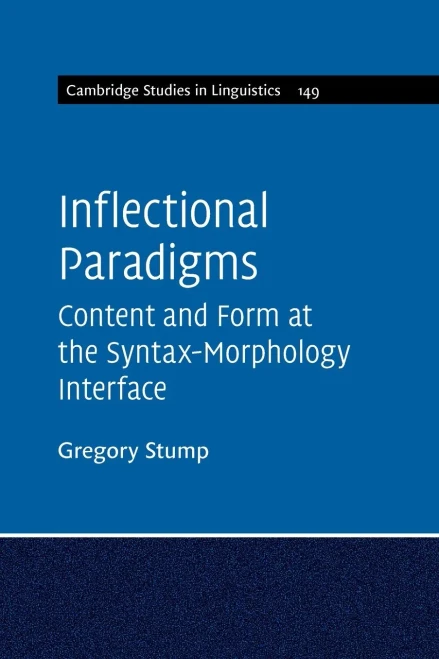

Inflectional Paradigms
Paperback or Softback 239 pages Dec 30, 2015
Millions of titlesEvery book you're looking for
Carbon-neutral shippingFree on orders over $39.99
Fast shipping worldwideDelivered to your door
Sometimes dismissed as linguistically epiphenomenal, inflectional paradigms are, in reality, the interface of a language's morphology with its syntax and semantics. Drawing on abundant evidence from a wide range of languages (French, Hua, Hungarian, Kashmiri, Latin, Nepali, Noon, Old Norse, Sanskrit, Turkish, Twi and others), Stump examines a variety of mismatches between words' content and form, including morphomic patterns, defectiveness, overabundance, syncretism, suppletion, deponency and polyfunctionality. He demonstrates that such mismatches motivate a new grammatical architecture in which two kinds of paradigms are distinguished: content paradigms, which determine word forms' syntactic distribution and semantic interpretation, and form paradigms, which determine their inflectional realization. In this framework, the often nontrivial linkage between a lexeme's content paradigm and its stems' form paradigm is the nexus at which incongruities of content and form are resolved. Stump presents clear and precise analyses of a range of morphological phenomena in support of this theoretical innovation.
- Author:
- Gregory Stump
- Publisher:
- Cambridge University Press
- Publication Date:
- Dec 30, 2015
- Number of pages:
- 239 pages
- Binding:
- Paperback or Softback
- ISBN-10:
- 1107460859
- ISBN-13:
- 9781107460850